Call It Agains and Throw a Better Ball

In baseball, the bullpen is the player who pitches the baseball game from the pitcher's mound toward the catcher to begin each play, with the goal of retiring a concoction, who attempts to either brand contact with the pitched ball or depict a walk. In the numbering system used to tape defensive plays, the pitcher is assigned the number one. The pitcher is often considered the nigh important player on the defensive side of the game, and as such is situated at the right end of the defensive spectrum. At that place are many unlike types of pitchers, such every bit the starting pitcher, relief pitcher, middle reliever, lefty specialist, setup human, and the closer.
Traditionally, the bullpen also bats. Starting in 1973 with the American League and spreading to further leagues throughout the 1980s and 1990s, the hitting duties of the pitcher have mostly been given over to the position of designated hitter, a cause of some controversy. The Japanese Fundamental League has not adopted the designated hitter position.
Overview [edit]
In near cases, the objective of the bullpen is to deliver the pitch to the catcher without allowing the concoction to striking the ball with the bat. A successful pitch is delivered in such a manner that the batter either allows the pitch to pass through the strike zone, swings the bat at the brawl and misses it, or hits the ball poorly (resulting in a pop wing or ground out). If the batter elects not to swing at the pitch, it is called a strike if any part of the brawl passes through the strike zone and a ball when no function of the ball passes through the strike zone. A cheque swing is when the batter begins to swing, merely and then stops the swing short. If the batter successfully checks the swing and the pitch is out of the strike zone, information technology is called a ball.
There are two legal pitching positions, the windup and the set position or stretch. Either position may be used at any time; typically, the windup is used when the bases are empty, while the set up position is used when at least one runner is on base. Each position has certain procedures that must be followed. A balk can be called on a bullpen from either position. A power pitcher is i who relies on the velocity of his pitches to succeed.[one] Generally, power pitchers record a high per centum of strikeouts. A command bullpen succeeds past throwing accurate pitches and thus records few walks.
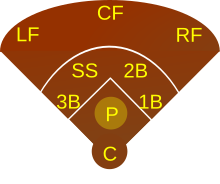
The position of the pitcher
Nearly all action during a game is centered on the pitcher for the defensive team. A bullpen's particular mode, fourth dimension taken between pitches, and skill heavily influence the dynamics of the game and tin oft determine the victor. Starting with the pin foot on the pitcher's rubber at the center of the pitcher's mound, which is lx anxiety 6 inches (18.44 m) from home plate, the pitcher throws the baseball to the catcher, who is positioned behind domicile plate and catches the brawl. Meanwhile, a batter stands in the concoction's box at one side of the plate, and attempts to bat the ball safely into off-white play.
The blazon and sequence of pitches called depend upon the particular situation in a game. Because pitchers and catchers must coordinate each pitch, a system of hand signals is used by the catcher to communicate choices to the pitcher, who either vetoes or accepts by shaking his caput or nodding. The relationship between bullpen and catcher is so important that some teams select the starting catcher for a particular game based on the starting pitcher. Together, the pitcher and catcher are known as the battery.
Although the object and mechanics of pitching remain the same, pitchers may be classified according to their roles and effectiveness. The starting pitcher begins the game, and he may exist followed by various relief pitchers, such as the long reliever, the left-handed specialist, the middle reliever, the setup human, and/or the closer.
In abbreviating baseball positions, P is used as a general designation for pitchers. SP and RP are sometimes used to differentiate starting and relief pitchers, respectively, while LHP and RHP are sometimes used to bespeak if a pitcher is left-handed or right-handed, respectively.[2]
In Major League Baseball, baseball rubbing mud is used to status game assurance before pitchers use them.[iii]
Pitching in a game [edit]
| A Navy pitcher releases the baseball game from the pitcher'south mound. | Delivery of the baseball from the pitcher to catcher |


A skilled pitcher frequently throws a variety of dissimilar pitches to prevent the batter from hitting the brawl well. The most basic pitch is a fastball, where the pitcher throws the brawl as difficult every bit he tin. Some pitchers are able to throw a fastball at a speed over 100 miles per hour (160 km/h; 150 ft/due south), ex., Aroldis Chapman. Other common types of pitches are the curveball, slider, changeup, cutter, sinker, screwball, forkball, split-fingered fastball, slurve, and knuckleball.[iv] These generally are intended to have unusual motility or to deceive the concoction every bit to the rotation or velocity of the ball, making it more difficult to striking. Very few pitchers throw all of these pitches, but most use a subset or blend of the basic types. Some pitchers as well release pitches from dissimilar arm angles, making it harder for the batter to pick up the flight of the ball. (Run into List of baseball game pitches.) A bullpen who is throwing well on a particular solar day is said to accept brought his "good stuff."
There are a number of distinct throwing styles used by pitchers. The near common style is a three-quarters delivery in which the pitcher'southward arm snaps downwards with the release of the ball. Some pitchers utilise a sidearm delivery in which the arm arcs laterally to the torso. Some pitchers use a submarine style in which the pitcher'due south trunk tilts sharply downward on delivery, creating an exaggerated sidearm motion in which the pitcher'due south knuckles come up very shut to the mound.
Constructive pitching is vitally important in baseball game. In baseball statistics, for each game, 1 bullpen will exist credited with winning the game, and one bullpen will be charged with losing information technology. This is not necessarily the starting pitchers for each squad, however, as a reliever tin get a win and the starter would then go a no-decision.
Rotation and specialization [edit]
Pitching is physically demanding, especially if the pitcher is throwing with maximum effort. A full game usually involves 120–170 pitches thrown by each team, and most pitchers brainstorm to tire before they reach this indicate. As a result, the pitcher who starts a game oftentimes volition not be the ane who finishes it, and he may not exist recovered enough to pitch again for a few days. The act of throwing a baseball game at high speed is very unnatural to the body and somewhat damaging to human muscles; thus pitchers are very susceptible to injuries, soreness, and full general pain.

Baseball game teams use ii strategies to address this problem: rotation and specialization. To accommodate playing most every twenty-four hour period, a team will include a grouping of pitchers who start games and rotate between them, assuasive each bullpen to residue for a few days betwixt starts. A team'due south roster of starting pitchers are usually not even in terms of skill. Exceptional pitchers are highly sought later and in the professional ranks describe large salaries, thus teams tin seldom stock each slot in the rotation with top-quality pitchers.
The best starter in the team's rotation is chosen the ace. He is unremarkably followed in the rotation by three or 4 other starters before he would be due to pitch again. Disallowment injury or exceptional circumstances, the ace is usually the pitcher that starts on Opening Twenty-four hour period. Aces are also preferred to offset crucial games late in the season and in the playoffs; sometimes they are asked to pitch on shorter rest if the squad feels he would be more effective than the fourth or 5th starter. Typically, the further down in the rotation a starting bullpen is, the weaker he is compared with the others on the staff. The "5th starter" is seen as the cutting-off between the starting staff and the bullpen. A team may have a designated 5th starter, sometimes known as a spot starter or that part may shift cycle to cycle betwixt members of the bullpen or Triple-A starters. Differences in rotation setup could also have tactical considerations as well, such as alternating right- or left-handed pitchers, in order to throw off the other team's hitting game-to-game in a series.
Teams accept additional pitchers reserved to supplant that game'south starting bullpen if he tires or proves ineffective. These players are chosen relief pitchers, relievers, or collectively the bullpen. Once a starter begins to tire or is starting to give up hits and runs a call is made to the pitcher to take a reliever outset to warm up. This involves the reliever starting to throw practice balls to a double-decker in the bullpen and so as to be ready to come in and pitch whenever the manager wishes to pull the electric current pitcher. Having a reliever warm up does not e'er mean he volition be used; the electric current bullpen may regain his sophistication and retire the side, or the manager may choose to go with another reliever if strategy dictates. Unremarkably, pitching changes will occur as a effect of a pinch hitter being used in the late innings of a game, especially if the pitcher is in the batting lineup due to not having the designated hitter. A reliever would and then come out of the bullpen to pitch the next inning.
When making a pitching alter a manager will come out to the mound. He will and so call in a pitcher by the tap of the arm which the next pitcher throws with. The manager or pitching coach may as well come out to talk over strategy with the pitcher, but on his second trip to the mound with the aforementioned pitcher in the same inning, the pitcher has to come out. It is considered proper etiquette for the pitcher to wait on the mound until the director arrives, whereby he then hands the manager the ball, and only so he is allowed to leave the field. Relief pitchers often take even more specialized roles, and the particular reliever used depends on the situation. Many teams designate one bullpen as the closer, a relief bullpen specifically reserved to pitch the final inning or innings of a game when his team has a narrow lead, in guild to preserve the victory. More than recently, teams began experimenting with an opener, a relief pitcher who starts a game merely only pitches at least the showtime inning. Other relief roles include ready-upwardly men, center relievers, left-handed specialists, and long relievers. Generally, relievers pitch fewer innings and throw fewer pitches than starters, simply they can ordinarily pitch more often without the need for several days of rest between appearances. Relief pitchers are typically pitchers with "special stuff", meaning that they have very effective pitches or a very unlike manner of delivery. This makes the batter see a very different mode of pitching in try to become them out. One case is a sidearm or submarine bullpen.

A bullpen for the DeLand Suns prepares to throw a pitch against the Lakeland Lightning. June 8, 2019.
Position players are eligible to pitch in a game too, this nevertheless is rare equally these players are not truly trained as pitchers and chance injury. (For example, in a 1993 game, Jose Canseco suffered a flavour ending arm injury after pitching 2 innings.) Plus, they tend to throw with less velocity and skill. For these reasons, managers volition typically only apply a position role player equally a pitcher in a blowout loss, or if they have run out of available pitchers in order to avoid a forfeit (the latter typically but happens in extra-inning games). Cliff Pennington of the Toronto Blueish Jays, who pitched 1/iii of an inning in game 4 of the 2015 American League Title Series en route to a 14–2 loss, was the only documented position actor to pitch during the postseason, until Austin Romine of the New York Yankees pitched the ninth inning of Game 3 in a xvi–i loss against the Boston Cerise Sox in the 2018 American League Division Series. The only regulation game in which both pitchers of tape were position players occurred on May 6, 2012, when the Baltimore Orioles' designated hitter Chris Davis was the winner in a xvi-inning game against Boston while Red Sox outfielder Darnell McDonald took the loss.
After the ball is pitched [edit]
The bullpen's duty does not stop after he pitches the ball. Unlike the other fielders, a bullpen and catcher must start every play in a designated area. The pitcher must exist on the pitcher'southward mound, with one human foot in contact with the pitcher's condom, and the catcher must be behind home plate in the catcher's box. Once the brawl is in play, however, the pitcher and catcher, like the other fielders, can respond to whatsoever part of the field necessary to make or assist in a defensive play.[5] At that point, the bullpen has several standard roles. The pitcher must attempt to field whatever balls coming upward the heart, and in fact a Gold Glove Laurels is reserved for the pitcher with the best fielding power. He must head over to start base of operations, to be available to cover it, on balls hit to the right side, since the first baseman might be fielding them too far to the baseman'due south right to reach first base of operations before the batter-runner tin. Except for the first baseman, the bullpen ordinarily has the shortest run to first base of operations of anyone, and is the second-most-likely person to brand a putout at start base by retrieving a fielded brawl thrown by an infielder (typically a first baseman). On passed balls and wild pitches, he covers dwelling house-plate when there are runners on. Also, he mostly backs upwardly throws to habitation plate. When there is a throw from the outfield to third base of operations, he has to support the play to third base of operations too.
Pitching biomechanics [edit]
The physical act of overhand pitching is complex and unnatural to the human anatomy. Near major league pitchers throw at speeds of seventy to 100 mph (110 to 160 km/h), putting high amounts of stress on the pitching arm. Pitchers are by far the almost frequently injured players and many professional person pitchers will accept multiple surgeries to repair damage in the elbow and shoulder by the end of their careers.
As such, the biomechanics of pitching are closely studied and taught by coaches at all levels and are an important field in sports medicine. Glenn Fleisig, a biomechanist who specializes in the analysis of baseball movements, says that pitching is "the nearly violent human motion ever measured."[half-dozen] He claims that the pelvis can rotate at 515–667°/sec, the torso can rotate at 1,068–ane,224°/s, the elbow can reach a maximal athwart velocity of ii,200–ii,700°/due south and the force pulling the bullpen's throwing arm abroad from the shoulder at brawl release is approximately 280 pounds-strength (1,200 N).[six]
The overhead throwing motion tin be divided into phases which include windup, early cocking, belatedly cocking, early acceleration, late dispatch, deceleration, and follow-through.[7] Preparation for pitchers frequently includes targeting one or several of these phases. Biomechanical evaluations are sometimes done on individual pitchers to aid determine points of inefficiency.[8] Mechanical measurements that are assessed include, merely are not express to, foot position at step foot contact (SFC), elbow flexion during arm cocking and acceleration phases, maximal external rotation during arm cocking, horizontal abduction at SFC, arm abduction, lead knee position during arm cocking, trunk tilt, height angular velocity of throwing arm and bending of wrist.[9] [ten] [11]
Some players begin intense mechanical training at a immature age, a exercise that has been criticized by many coaches and doctors, with some citing an increase in Tommy John surgeries in recent years.[12] Fleisig lists 9 recommendations for preventative care of children'due south arms.[xiii] 1) Sentry and respond to signs of fatigue. 2) Youth pitchers should not pitch competitively in more than than 8 months in any 12-month period. 3) Follow limits for pitch counts and days of rest. 4) Youth pitchers should avert pitching on multiple teams with overlapping seasons. 5) Youth pitchers should learn adept throwing mechanics as soon as possible: bones throwing, fastball pitching and change-up pitching. 6) Avert using radar guns. vii) A pitcher should not too be a catcher for his/her team. The pitcher catcher combination results in many throws and may increase the risk of injury. viii) If a pitcher complains of pain in his/her elbow, go an evaluation from a sports medicine physician. ix) Inspire youth to accept fun playing baseball and other sports. Participation and enjoyment of various activities will increase the youth's athleticism and involvement in sports.[13]
To counteract shoulder and elbow injury, coaches and trainers have begun utilizing "jobe" exercises, named for Dr. Frank Jobe, the pioneer of the Tommy John procedure.[14] Jobes are exercises that have been developed to isolate, strengthen and stabilize the rotator cuff muscles. Jobes can be done using either resistance bands or lightweight dumbbells. Common jobe exercises include shoulder external rotation, shoulder flexion, horizontal abduction, prone abduction and scaption (at 45°, 90° and inverse 45°).
In add-on to the Jobes exercises, many pitching coaches are creating lifting routines that are specialized for pitchers. Pitchers should avert exercises that deal with a barbell. The emphasis on the conditioning should be on the legs and the cadre. Other body parts should be worked on but using lighter weights. Over lifting muscles, particularly while throwing ordinarily ends upwards in a strain muscle or possible a tear.
Equipment [edit]
Other than the catcher, pitchers and other fielders wear very few pieces of equipment. In general the ball cap, baseball game glove and cleats are equipment used. Pitchers may also keep with them at the mound a bag of powdered rosin. Treatment the bag applies a small layer of the rosin to the pitcher'south fingers in gild to increase his grip on the ball.
Currently there is a new trend of introducing a bullpen helmet to provide head protection from batters hitting line drives back to the pitcher. As of January 2014[update], MLB approved a protective pitchers cap which can be worn by any bullpen if they choose.[15] San Diego Padres relief pitcher, Alex Torres was the first player in MLB to wear the protective cap.[sixteen]
1 style of helmet is worn on top of the ballcap to provide protection to the brow and sides.[17]
In softball, a full face helmet is bachelor to all players including pitchers.[18] These fielder'southward masks are becoming increasingly popular in younger fast pitch leagues, some leagues fifty-fifty requiring them.
See likewise [edit]
- Pitching machine
- List of baseball pitches
- Baseball fielding positions
- Cy Immature Award winners
- Listing of Major League Baseball career wins leaders
- Bowler – similar position in cricket
- American Sports Medicine Institute – Pitching Biomechanics Evaluation
References [edit]
- ^ "Velocity". Merriam-Webster, Incorporated. 2007. Retrieved Baronial x, 2007.
- ^ "Baseball game Acronyms – Abbreviations". predictem.com. June 21, 2018. Retrieved June eleven, 2020.
- ^ Schneider, Jason (July iv, 2006). "All-American mud needed to take shine off baseballs". The Florida Times-Marriage . Retrieved October 6, 2009.
- ^ "Pitch Types". mlb.com. Major League Baseball. Retrieved May 17, 2019.
- ^ Baseball game Explained, by Phillip Mahony. McFarland Books, 2014. See www.baseballexplained.com Archived Baronial 13, 2014, at the Wayback Machine
- ^ a b Dean, J. (October 2010). "Perfect Pitch". WIRED. Vol. eighteen, no. 10. p. 62.
- ^ Benjamin, Holly J.; Briner, William W. Jr. (2005), "Piddling League Elbow", Clinical Journal of Sport Medicine, fifteen (1): 37–xl, doi:10.1097/00042752-200501000-00008, PMID 15654190, S2CID 8777889
- ^ "Pitching Biomechanical Evaluation". Archived from the original on March 16, 2008. Retrieved May 25, 2008.
- ^ Whiteley, R. (2007). "Baseball throwing mechanics every bit they relate to pathology and performance – A review". Journal of Sports Science & Medicine. half-dozen (1): ane–xx. PMC3778685. PMID 24149219.
- ^ Barrentine, S. W.; Matsuo, T.; Escamilla, R. F.; Fleisig, Chiliad. South.; Andrews, J. R. (1998). "Kinematic Analysis of the Wrist and Forearm during Baseball Pitching". Journal of Applied Biomechanics. fourteen (1): 24–39. doi:10.1123/jab.14.i.24. S2CID 16614797.
- ^ Matsuo, Tomoyuki; Matsumoto, Tsuyoshi; Takada, Yoshihiro; Mochizuki, Yoshiyuki (June 1999). Influence of dissimilar shoulder abduction angles during baseball pitching on throwing performance and joint kinetics. Scientific Proceedings on the XVIII International Syposium on Biomechanics in Sports. Perth, Australia. pp. 389–392.
- ^ Rick Peterson (February 6, 2009). "Pitching Perspectives with Rick Peterson: Understanding the Epidemic of Youth Pitching Injuries". fullcountpitch.com. Archived from the original on February 9, 2009.
- ^ a b Fleisig, G. Southward.; Weber, A.; Hassell, N.; Andrews, J. R. (2009). "Prevention of elbow injuries in youth baseball pitchers". Electric current Sports Medicine Reports. 8 (five): 250–254. doi:x.1249/jsr.0b013e3181b7ee5f. PMC3435945. PMID 19741352.
- ^ Jeran, J. J.; Chetlin, R. D. (2005). "Training the shoulder complex in baseball pitchers: A sport-specific approach". Strength and Workout Journal. 27 (four): 14–31. doi:10.1519/1533-4295(2005)27[14:ttscib]2.0.co;2.
- ^ "Pitchers' protective caps approved". ESPN.com. January 28, 2014.
- ^ "Who was the first pitcher to wear protective headgear". July 1, 2014. Archived from the original on March 4, 2015.
- ^ "New Pitching Helmet Prototype Unveiled by Easton-Bell Sports". Reuters. March 7, 2011. Archived from the original on April vii, 2014. Retrieved April 18, 2014.
- ^ "Softball Helmet: Selection and prices for the popular models". Fastpitch-softball-coaching.com. March 21, 2014. Retrieved April 18, 2014.
Farther reading [edit]
- Ballard, Chris; Good, Owen (October 17, 2011). "The Invisible Fastball: Six decades ago a pocket-sized league bullpen accomplished something we'll never see again". Sports Illustrated . Retrieved October xix, 2011.
When [Kelly] Jack Swift arrived in Elkin, Northward.C., in late 1951, he was nobody's idea of a prospect.
Source: https://en.wikipedia.org/wiki/Pitcher
0 Response to "Call It Agains and Throw a Better Ball"
Post a Comment